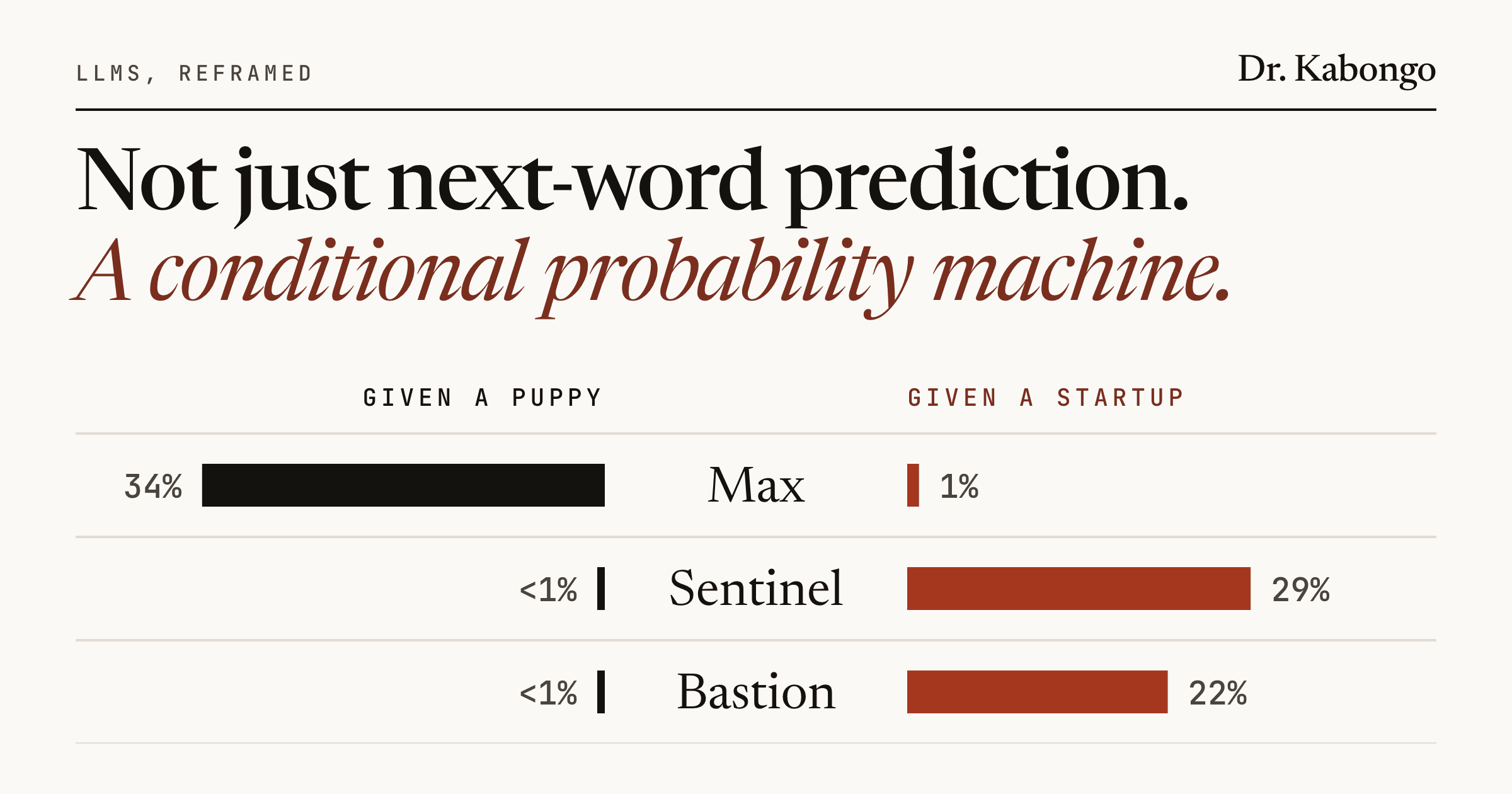
“LLMs are just next-token predictors.”
Technically true. But I think it only tells half the story.
I prefer another name: conditional probability machines.
It sounds more technical, I know. But one word in there changes how you use these tools: conditional.
When a model writes its next word, it isn’t asking “what word usually comes next?” It’s asking “what word comes next, given everything I’ve seen so far?”
In math, we write it like this:
P(next word | everything before it)
That little vertical bar means “given.” And it’s doing all the work.
“Everything before it” is much more than your last question:
- the instructions you typed
- hidden system instructions from the app
- the files and documents you uploaded
- the full chat history
- search results and tool outputs
- the words the model has already written in its own answer
Try it: same request, different conditions
Below, the request is always “Suggest a name.” You can’t edit it. What you can do is add lines earlier in the conversation, and watch the model’s probabilities move.
Interactive · illustrative demo
Same request. Change the condition.
1 · Build the condition
Tap a line to put it earlier in the conversation. Tap it again to take it out. The last line is fixed.
- You, nowSuggest a name.Locked. The request never changes.
- Words of the request changed
- 0
- Lines of context added
- 1
2 · What the model is likely to say
If it answers with a name, how likely is each one?
- Max34%
- Bella27%
- Sunny15%
- Alex3%
- Nova2%
- Sentinel<1%
- Bastion<1%
- Cipher<1%
- Other names18%
With your conditionWith no context
Most likely: Max, 34%. With no context, Max had 12%.
Each ask is one random draw from the bars above. Same request, same model, different answers.
An illustrative demo, not a live model. The probabilities are hand-written to show the mechanism. A real model spreads them over tens of thousands of possible words and reads far longer conditions.
Three things to try:
- Add the puppy line. “Max” and “Bella” take over. Now swap it for the cybersecurity startup: “Max” drops to 1%, and “Sentinel” and “Bastion” take over.
- Remove everything. With nothing to go on, no name gets more than 12%. The model falls back on the most average answers.
- Add the puppy and the startup together. The condition now pulls two ways, so the answer blurs. Add the branding consultant on top of the startup and it sharpens.
The request never changed. The model didn’t change. The condition did.
This holds for every LLM: Gemini, GPT, Claude, Llama, all of them. The model decides how it reacts to context. You decide what the context is.
What “given” really means
The vertical bar in P(A | B) is the slippery part. Here is the intuition: conditioning means narrowing the world, then recounting.
- Start with every conversation you could imagine.
- Throw away the ones where the condition (B) isn’t true.
- In what’s left, count how often the event (A) happens.
That’s all. The denominator shrinks, and so the probability changes. Try it on 200 imagined conversations:
Interactive · illustrative demo
Narrow the world, then recount.
Picture 200 conversations, each one ending with an answer to “Suggest a name.” Pick a question, then add a condition and watch the world shrink.
The chance that…
…given that…
The event happensCondition holds, event doesn’tRuled out by the condition
Count what is left
34%P(Max | puppy) = 17 ÷ 50
In 50 conversations, the context mentions a puppy. In 17 of them, the answer is “Max”.
count(both) ÷ count(condition)
Flip it
71%P(puppy | Max) = 17 ÷ 24
Same two events, a different question, a different answer.
An imagined set of 200 conversations, built to match the numbers in the first demo. It is a picture of the idea, not data from a real model.
Two things worth noticing:
- “Max” is 12% likely in general, but 34% likely given a puppy, and 1% given a startup. Same event, three different worlds, three different answers.
P(A | B)is notP(B | A). Given a puppy, the answer is “Max” 34% of the time. But given that the answer was “Max”, there’s a puppy in the context 71% of the time. The lab shows both numbers, and “Swap the two” turns the flipped question into the main one. Mixing up the two is one of the most common mistakes in probability.
An LLM does this at every single word. It has learned which words tend to follow contexts like yours. Your context decides which part of the world it is counting in.
Three things this explains
Vague prompts get generic answers. Give the model little to condition on, and the distribution stays wide: that’s the flat “no context” bars above. The likeliest continuation of almost nothing is the most average text.
Long chats drift. Everything in the conversation keeps counting: the outdated plan, the idea you abandoned, the assumption you never confirmed. Old information is still sitting in the condition, still pulling on every prediction.
One early mistake snowballs. The model’s own words become part of the condition for everything that follows. A wrong assumption in step two is now “given” in steps three, four and five, and each step builds on it as if it were true.
“You’re right, I missed that.”
Many of us have lived this moment with a coding agent.
The code is written. All the unit tests pass. The deploy shows no errors. Then something breaks in production, and there’s real downtime. You paste the logs into the chat, and the agent replies:
“You’re right, I missed that. Here’s the fix.”
And the fix works. So why didn’t it get it right the first time?
Through this lens, the answer is simple: it didn’t miss it. It never had it.
When the code was written, the production logs weren’t part of the condition. What was there: your request, the code, and a green test run. Given all that, “done, everything looks good” was the most likely thing to say. Then you pasted the log. The condition changed, so the output changed.
“I missed that” isn’t a memory of a failure. There was no earlier moment where the model saw the problem and looked away. It’s simply a very likely thing to say when a user pastes an error under a message that said “done.” The model didn’t know until it was finally told.
And in a new chat, it won’t remember being told either, unless something puts the lesson back into the condition.
Harnesses and skills build the condition for you
If the condition is everything, then the real work of using AI is building it, and building it reliably, not from memory at 6 pm on a Friday.
That’s what the software around the model is for. A harness, the agent tool wrapped around the model, decides what goes into the context before the model says a word: the system instructions, which files get read, which tools can be called, what the test runner and the logs send back, and the project’s instruction file.
Skills are packaged conditions. A skill is a reusable bundle of instructions (and sometimes scripts) that the harness loads when a task calls for it. For example, a deploy skill that says: after deploying, read the logs for ten minutes, check the error rate, and report back before calling it done.
Apply that to the downtime story:
- Give the agent a tool that reads production logs and metrics, so they can be in the condition.
- Put the post-deploy check into a skill or a hook, so that every deploy carries it.
- Write the incident’s lesson into the project’s instruction file, so the next session starts with it.
None of this makes the model smarter. It makes the condition better, on every run.
Why engineers stay in the loop
A model can only condition on what it’s given. And it can’t notice what’s missing, because from the inside, missing information doesn’t look like anything.
Engineers are the ones who know what is not in the window: how production really behaves, what the customer was promised, what “done” means here, and what an outage costs. That’s why we stay in the loop:
- We decide which conditions matter, and notice when one is missing.
- We verify against the real world (logs, metrics, users), not just against the green tests the model could see.
- We own the consequences. The model produces the most probable continuation. Accountability can’t be probable.
The point isn’t that AI needs babysitting. It’s that someone has to design the conditions, and check them against reality.
What I do in practice
- Give the context a smart colleague would need: who it’s for, the goal, the constraints
- Paste the source material instead of hoping the model “knows” it
- Give agents the same signals I’d look at myself: logs, metrics, test output
- Turn lessons into reusable conditions: instruction files, skills, hooks
- When a chat gets messy, start fresh with a clean summary
Don’t just ask a better question. Build a better condition.
“Next-token prediction” describes what the model does.
“Conditional probability” describes what you control.
Have you had an “I missed that” moment with a coding agent? What was missing from its context? Tell me in the comments below.
Comments
Loading comments…